
The King and Queen County Inmate Population
King and Queen County does not run a separate county jail roster from a county-owned detention building. The official local custody point is Middle Peninsula Regional Security Center, a regional jail in Saluda serving Essex, King and Queen, King William, Mathews, and Middlesex counties. That means the best public count for the King and Queen County inmate population is a regional count, not a county-only head count. MPRSC publishes the current inmate listing for people in that regional jail, while the King and Queen County Sheriff's Office remains the local law-enforcement agency for arrests and sheriff-created records.
The King and Queen County inmate population changes as arrests, magistrate release decisions, bond hearings, court commitments, transfers, and releases occur. A person arrested in King and Queen County may be booked at MPRSC, released before booking, transferred to Virginia Department of Corrections after sentencing, held under another agency's authority, or no longer be in custody. For that reason, a current jail roster search should be read as a point-in-time custody tool. It is not a complete archive of every past King and Queen arrest.
The MPRSC homepage is the source for the facility name, member jurisdictions, address, phone, and rated capacity. The homepage screenshot captured for this build shows the same regional facility context used for King and Queen County inmate population research.
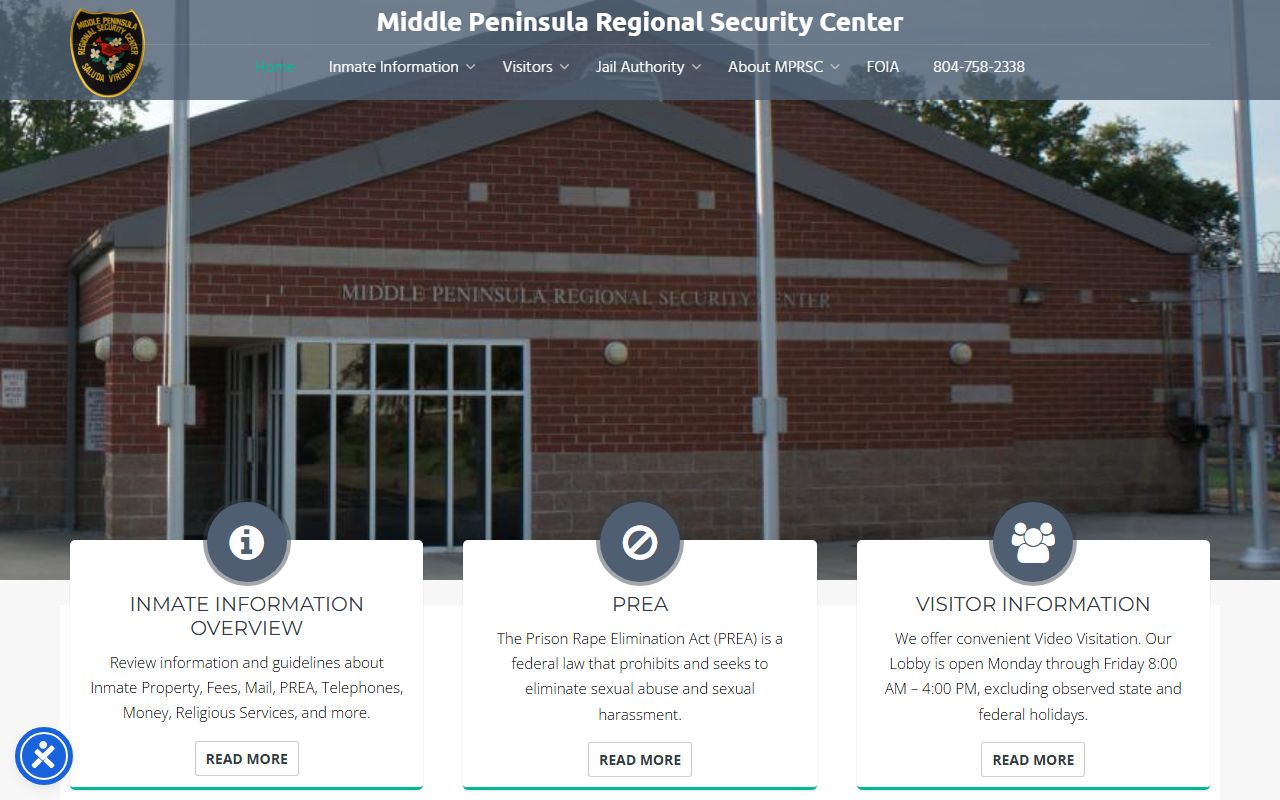
Because the jail is regional, the screenshot should be read as a service-area source. It does not split the population by each member county.
King and Queen County Inmate Population Statistics
The most concrete King and Queen County inmate population figures in the research come from MPRSC's own facility pages and live roster. MPRSC states a rated capacity of 121 inmates. The direct current-inmate grid displayed 144 items when inspected on July 1, 2026. That one-day roster count was 23 people above the stated rated capacity, or about 119 percent of rated capacity. It should not be labeled as an average daily population because the research did not locate an official MPRSC average daily population table.
| Measure | Figure | Source / Date |
|---|---|---|
| MPRSC rated capacity | 121 inmates | MPRSC homepage, inspected July 1, 2026 |
| MPRSC live current roster count | 144 items | Direct MPRSC roster grid, inspected July 1, 2026 |
| Capacity difference | 23 over rated capacity, about 119 percent | Calculated from the two official figures above |
| King and Queen-only jail population | Not published separately | MPRSC roster does not show committing county in the visible grid |
| Annual bookings or average stay | Not located in official sources | MPRSC and county source sweep |
King and Queen County Inmate Population Trends
The research did not locate a clean annual MPRSC average-daily-population series, county-of-commitment split, or booking total. The available trend data is narrower but still useful. The Board of Local and Regional Jails CY2024 annual report gives a facility death-review context, and the live roster gives a current operating snapshot. These sources support limited statements only: MPRSC reported zero deaths in custody for three calendar years, and the live roster count exceeded stated capacity on July 1, 2026.
| Year or Date | Population or Event | Use in King and Queen County Context |
|---|---|---|
| CY2022 | 0 deaths in custody | BLRJ facility table for MPRSC |
| CY2023 | 0 deaths in custody | BLRJ facility table for MPRSC |
| CY2024 | 0 deaths in custody | BLRJ facility table for MPRSC |
| July 1, 2026 | 144 current roster items | Official MPRSC live roster grid |
Those figures do not prove a multi-year overcrowding trend. They do show that the serving regional jail had a documented count above its stated capacity on the inspection date, and they give a verified safety-reporting point for recent years. No official source in the research sweep showed a recent King and Queen jail construction plan, closure, consent decree, or jail-specific litigation item tied to MPRSC.
King and Queen County Inmate Record Fields
MPRSC's public roster publishes individual fields that help users read the King and Queen County inmate population, but it does not publish an aggregate demographic report. The visible roster grid shows Full Name, Age, Race, Sex, and Admit Date. The grid configuration also exposes First Name, Middle Name, Last Name, Primary Charge Court Type, and Primary Charge as hidden or adaptive fields. It did not show a committing county field, so a row count cannot be assigned solely to King and Queen County.
- Age shows the person's age as a visible roster value.
- Race and sex appear as short coded values, but no aggregate table is published.
- Admit date shows when the person entered MPRSC custody.
- Primary charge exists as a hidden or adaptive field, not as a default main-grid field.
- Mugshot, bond, housing, and court date were not visible in the main public roster grid.
King and Queen County Jail Capacity
The capacity question is regional. MPRSC lists a rated capacity of 121 inmates, and the inspected roster displayed 144 current inmates across all member jurisdictions. That makes the serving regional jail the right facility to review for King and Queen County jail capacity, but it also requires careful wording. The public count was a one-day roster count, not a monthly average or annual average daily population. It should be used as a current snapshot and not stretched into a long-term finding.
Capacity matters for search users because it can affect transfers, housing decisions, and timing. A person may appear on the MPRSC roster after a King and Queen County booking, then leave the list after release, transfer to another local jail, transfer to VADOC, or movement under a court order. The public roster does not show housing unit or transfer notes in its default view, so the MPRSC phone line and records-request route matter when the online listing is too thin.
Laws Governing King and Queen County Inmate Records
Virginia public-access law is the frame for King and Queen County inmate records. The regional jail roster is public-facing, but records beyond the visible roster may require a request to the record holder. Jail custody records are not the same as sheriff investigative files, and neither is the same as a court case record. Virginia FOIA also requires existing records, not new summaries created on demand.
Key Virginia access rules:
Virginia Code Section 2.2-3700 states the public-record policy and says access rules are read in favor of openness unless an exemption applies.
Virginia Code Section 2.2-3704 covers request methods, response duties, and actual-cost charges for public records.
Virginia Code Section 2.2-3706 governs law-enforcement and criminal-record disclosure, including rules relevant to adult arrestee photographs.
6VAC15-40 sets minimum standards for Virginia jails and lockups.
Virginia Code Section 9.1-192.1 requires civilian death-in-custody reporting.
King and Queen County State Prison Search
Sentenced state prisoners from King and Queen County are searched through the Virginia Department of Corrections Inmate and Supervisee Locator, not through the MPRSC roster after transfer. VADOC covers people in state prison custody, probationers and parolees supervised by district offices, institutional hospitals, some people housed in local or regional jails under VADOC authority, and Community Corrections Alternative Program participants. The locator is updated daily, but VADOC warns that data may be inaccurate or outdated.
The research did not locate a VADOC prison physically inside King and Queen County. A VADOC district office context serves Gloucester, Mathews, Middlesex, King and Queen, King William, and West Point from Gloucester, but that is community supervision, not a prison facility. When an MPRSC search does not find a person, VADOC is the next state-custody channel if felony sentencing or state supervision may be involved.
Search the King and Queen County Inmate Population
The official current-custody path for a King and Queen County inmate search is the MPRSC Current Inmate Listing. The wrapper page says the listing can be slow and provides a direct grid at http://146.168.173.101/DCN/inmates. The roster is free, public, and did not require a login or payment in the research capture. It uses a data grid, not a single search form.
Before searching, gather the person's full name and any likely spelling variants. A booking number was not visible as a default public field, and the grid does not operate like a consumer-background site. It is a current-inmate roster. If the person has been released, transferred, sentenced to VADOC, held federally, or held by ICE, another search channel may be needed.
- Open the MPRSC current inmate listing wrapper page, then use the direct roster link if the embedded frame does not load.
- Use the filter row below the grid headers. Type the name into Full Name, or filter by age, race, sex, or admit date.
- Use sorting, grouping, and pagination if the person is not on the first page.
- Open adaptive details if the grid offers them, because Primary Charge and Primary Charge Court Type may be hidden from the main view.
- Call MPRSC at 804-758-2338 or use FOIA if the online list is unavailable or does not show the record needed.
King and Queen County Roster Lookup Fields
The roster search field table is one of the most useful local details. The public grid lets users filter several visible columns and may expose more detail through adaptive controls. This is different from a county database that asks for a last name and returns a profile page. The MPRSC system is closer to a sortable live jail list.
| Field Label | Type | Required | Notes |
|---|---|---|---|
| Full Name | Text filter | No | Main visible column and best first search field. |
| Age | Text or numeric filter | No | Useful when several names are similar. |
| Race | Text filter | No | Observed values included W and B. |
| Sex | Text filter | No | Observed values included M and F. |
| Admit Date | Date or text filter | No | Displayed in M/D/YYYY format. |
| Primary Charge | Hidden or adaptive field | No | Listed in grid configuration but not visible in the default main table. |
| Page size | Dropdown | No | Options include 10, 20, 50, 100, 200, and all. |
The direct MPRSC roster grid screenshot shows the filter row, current list format, and pagination used for King and Queen County inmate population searches.
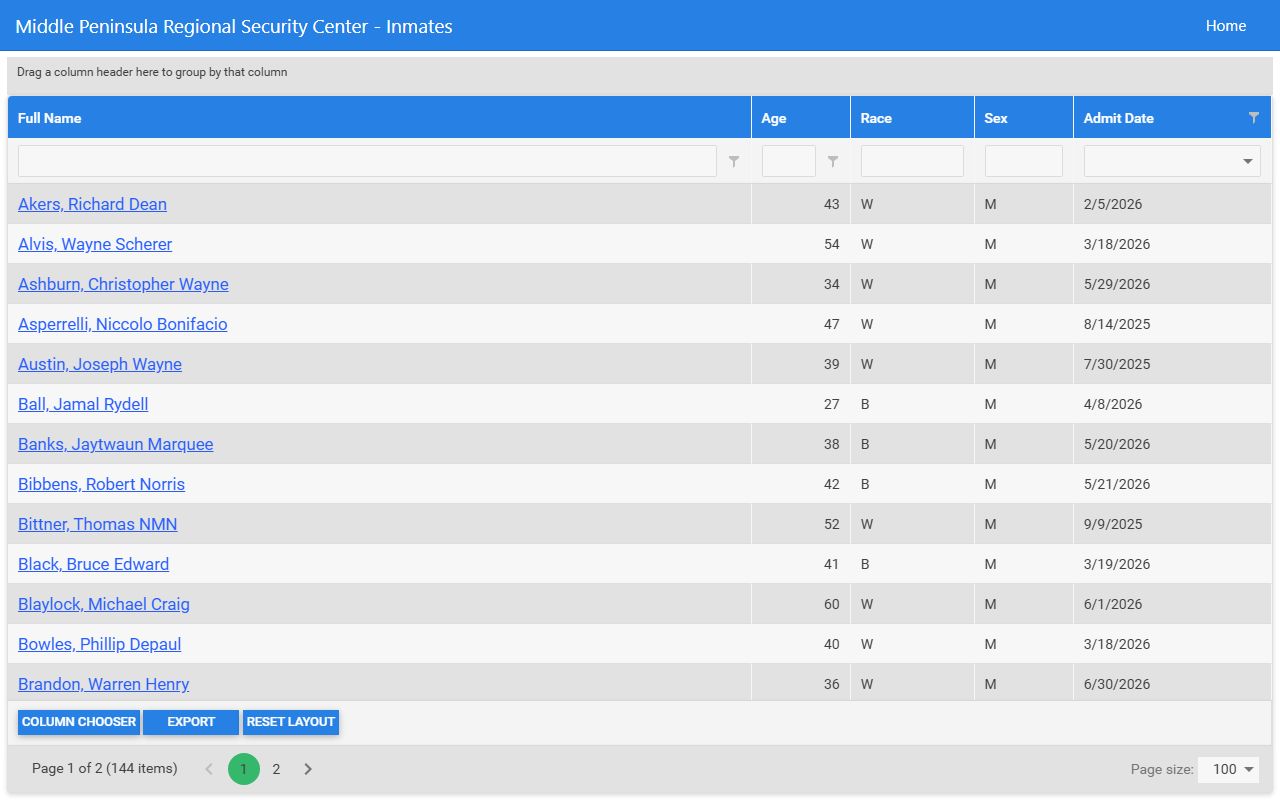
The grid format explains why a failed name search may be a filter or pagination issue rather than proof that the person was never booked.
Past King and Queen County Inmate Records
MPRSC's public list is a current-inmate listing. The research did not document an archive of released inmates, a daily booking PDF, or a public search for historical MPRSC bookings. For past King and Queen County inmate records, the correct path depends on the record holder. MPRSC handles jail custody and booking records. The King and Queen County Sheriff's Office handles sheriff-created arrest reports, warrant service records, and investigative records. Courts handle case records after charges enter General District Court or Circuit Court.
Virginia FOIA requests may be made by mail, fax, email, in person, or phone. A useful request should name the person, approximate booking or arrest date, type of record sought, and desired format. MPRSC's FOIA officer is Andrea Kinser at 170 Oakes Landing Road, Saluda, VA 23149, 804-758-2338 ext. 253, fax 804-758-4295, ahogge@mprsc.org. Sheriff FOIA requests are routed to Sheriff W. R. Balderson, P.O. Box 38, King and Queen Court House, VA 23085, 804-785-5486, vdraine@kqso.net.
What King and Queen County Inmate Records Show
A King and Queen County inmate record in the public MPRSC roster is limited. It is enough to confirm current custody and basic identifying details, but it is not a full booking packet. Court dates, bond amounts, booking numbers, housing unit, arresting agency, full physical description, and mugshots were not visible in the default public grid capture. A user who needs more than the grid shows should use the phone or public-records request path.
| Roster Field | What It Shows |
|---|---|
| Full Name | The displayed name on the current inmate list. |
| Age | The person's current age as published by the roster. |
| Race | A short race code in the visible grid. |
| Sex | A short sex code in the visible grid. |
| Admit Date | The date the person entered MPRSC custody. |
| Primary Charge | A hidden or adaptive field, not a default visible column. |
| Mugshot and Bond | Not visible in the main public roster grid inspected for this research. |
King and Queen County Jail vs Prison Lookup
Search tools follow custody status. MPRSC covers local and regional jail custody, including pretrial detainees and local sentences. VADOC covers state prison custody and state supervision after sentencing or transfer. BOP and ICE are separate federal systems. VINELink can provide custody and case notifications, but it is not a booking-record archive.
| Custody Type | Where to Look | What It Covers |
|---|---|---|
| Regional jail custody | MPRSC current inmate listing | People currently held at the serving regional jail. |
| State sentenced or supervised | VADOC Inmate and Supervisee Locator | State prison, parole, probation, CCAP, and related VADOC authority. |
| Federal sentence | BOP Inmate Locator | Federal inmates incarcerated from 1982 to present. |
| Immigration detention | ICE Online Detainee Locator | People in ICE custody by A-number or biographical data. |
VADOC, BOP, ICE, and VINE
A missing MPRSC result does not end the King and Queen County inmate lookup. Use the VADOC locator when the person may have been sentenced to state custody. Use the BOP Inmate Locator for federal sentenced prisoners, especially if a federal prosecution or U.S. Marshals transfer is involved. Use the ICE Online Detainee Locator for immigration custody searches. Use Virginia VINELink for custody or case notifications.
The research did not locate a King and Queen Sheriff's Office app or MPRSC app that offers an app-only roster. Securus and Virginia VINE may use app workflows for visits or notifications, but those are vendor or state services, not county sheriff apps.
King and Queen County Detention Facilities
The facility map contains one detention facility serving King and Queen County. It is not in King and Queen Court House. The facility is in Saluda and serves five Middle Peninsula jurisdictions. The county sheriff, courts, and Commonwealth's Attorney are clustered around Allens Circle in King and Queen Court House, while jail custody is handled at the regional jail.
- Middle Peninsula Regional Security Center - regional jail for Essex, King and Queen, King William, Mathews, and Middlesex counties, holding pretrial detainees, local sentenced inmates, weekend inmates, work-release participants, EIP participants, and people awaiting transfer.
King and Queen County Inmate Population FAQ
How big is the King and Queen County inmate population?
The only current public count found was the MPRSC live roster count, which showed 144 current roster items on July 1, 2026. That is a regional jail count across member jurisdictions, not a King and Queen-only count.
Where does a King and Queen County inmate search start?
Start with the MPRSC Current Inmate Listing. Use the direct roster grid if the embedded page is slow, then call MPRSC if the record is unclear or the roster does not load.
Why is someone not on the MPRSC roster?
The person may have been released, transferred, sentenced to VADOC, held by another agency, held federally, detained by ICE, searched under a different name, or not booked into MPRSC.
Does the roster show mugshots?
The inspected MPRSC public grid did not show mugshots. Booking photographs may be requested through the proper Virginia FOIA route, subject to legal limits.